
A serendipitous coffee with another parent at my son’s school led to three meetings with a company whose best new product was the first thing every customer crossed off the quote.
We got to talking at drop-off. One coffee turned into a real conversation, and the conversation turned into a problem worth chewing on across a few sessions.
The company, call it Acme Co., is the kind you’d want to own. Healthy. Growing steadily. And quietly brilliant at the unglamorous work: they had taken so much cost out of their operation that their margins became the envy of the category.
Here’s the trap inside that success. When you make fat margins and steady top-line growth look easy, everyone expects you to keep doing it. The number has to go up next year too, at the same margin.
So they did what disciplined companies do when the core is fully squeezed. They expanded into an adjacency.
Adjacencies look safe. They aren’t.
Bain studied corporate growth for five years and found that moves into adjacent markets fail roughly 3 out of 4 times.
The ones that work are built on a strong core and a repeatable formula. The ones that fail wander.
Acme didn’t wander.
The adjacency was rational. Any buyer could look at it and understand why they’d be there. But it sat next to their expertise, not on top of it. And the customer for the adjacency wasn’t their old customer. It was a new customer, with a different buying cycle, buying a different thing in a different part of the stack.
Which is why they reached for one of the smartest channel plays in tech history.
The Intel Inside bet.
Remember Intel Inside. You never bought a CPU. You bought a Compaq or a Dell, and you wanted to know the thing inside it had the horsepower to deliver. Intel made the ingredient famous so the buyer would ask for it by name, and the PC makers would pull it through to win the sale.
It worked because Intel created the demand first. They spent more than $110 million in the campaign’s opening year teaching consumers to want a chip they would never see (per Intel’s own campaign history). Ad Age later called it the most effective co-op advertising program ever run.
Every component maker since has slapped a sticker on the box and waited for the same magic. Almost none of them got it, because they skipped the expensive part: making the end customer actually want the ingredient.
Acme had built the same shape. Half a dozen heavyweight partners own the relationships in this market. The company brings IP those partners can’t replicate, which lets the partner sell a richer solution, charge more, and capture more of the customer’s wallet. Some of that flows back upstream.
Sit across from a partner and the pitch lands clean: we won’t compete with you, we’ll help you make more money on the customer you already have.
Of course the partnerships came together!!! Why wouldn’t they.
Then the customer shows up.
Here’s where the deck meets the deal.
The end customer has never had this offering available in this space. The product solves a real problem they probably have. But they don’t know they have it.
Picture the moment. The customer comes to the partner for the thing they came to buy. The partner, doing exactly what the plan asks, adds Acme Co.’s value-added product to the quote. The customer looks at that line item and asks the most dangerous question in selling: why would I want this?
Now one of two things happens. Maybe the partner’s rep is sharp enough to explain the problem on the spot, and the customer bites. More often, the customer says some version of: I didn’t come in for that, I need to go check whether I even have this problem. Or, worse, they’re trying to trim the bill… and that unfamiliar line is the easiest cut in the whole quote. No haggling, no giving up the partner’s own margin. Just delete the thing nobody asked for.
So the add-on doesn’t merely fail to sell. It becomes the partner’s negotiating gift, the line they remove to look generous without touching their own price. Putting it on the quote can actually help the partner close, which is a special kind of cruel.
The deal isn’t lost to a competitor, it’s lost to nothing: 40 to 60 percent of qualified deals end in no decision.

It looks like an education problem. It’s an awareness problem.
This is the distinction the whole engagement turned on.
Education assumes the customer already knows they have a problem and wants help comparing solutions. Hand them a data sheet, line up the specs, win on the comparison. That works beautifully when someone walks in pre-qualified and already shopping.
Awareness is the step before that. The customer doesn’t know the problem exists, or doesn’t feel its size. No data sheet fixes that, because a data sheet answers a question they haven’t asked yet.
And here’s the harder cut underneath it. There’s a real difference between an unsolved problem and an undersolved one.
An unsolved problem is one we’ve quietly made peace with.
There’s no good answer out there, so we’ve accepted the bad version of reality and stopped looking. Buying behavior is brutal to trigger, because nobody shops for a fix to a thing they’ve decided is just how it is.
An undersolved problem is the opposite.
People already know it’s a problem. They already spend against it. They’re hunting for the next, better, faster version. The buying behavior is already in motion. You just have to be the better answer when they get there.
That’s why awareness alone never closes the sale: the buyer also has to believe that leaving the problem unsolved costs more than fixing it, and both have to land in the same breath.
The move: turn the unsolved into the undersolved.
So the work isn’t to invent demand. It’s to find the demand that already walked in the door and attach to it.
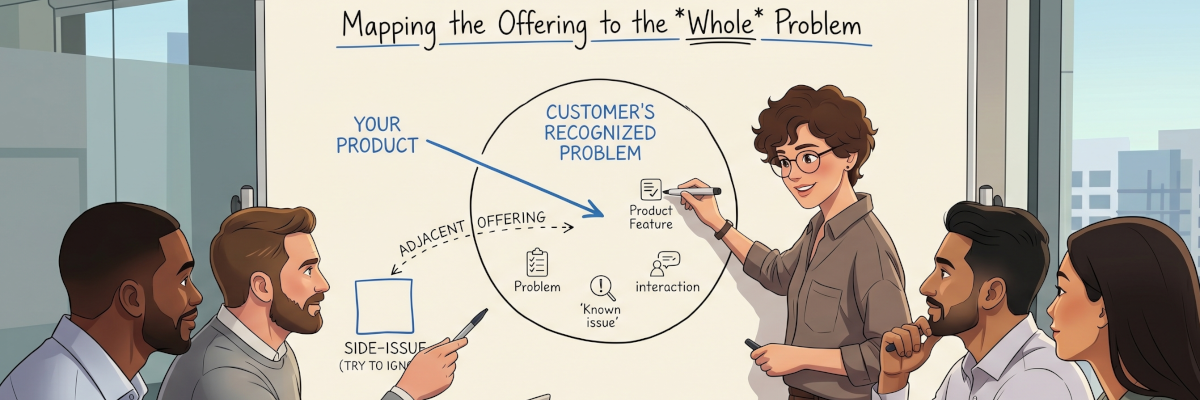
The customer showed up to solve something. Your job as the product leader is to make the problem space they already recognize large enough that your offering lands inside it, not beside it. Not “here is an adjacent thing you should also care about.” Instead: “the problem you came to fix is bigger than you realized, and this is simply what solving it properly looks like.”
Practically: audit each offering in the adjacency. Where you can honestly fold it into demand that already exists, do it. Stop selling a new category and sell a more complete version of what the customer already decided to buy. That’s also what rescues the channel play, because a partner can’t sell awareness inside a five-minute quote, but they can sell “the complete version of what you came for.”
Engineering the luck.
This is what engineering luck actually looks like in go-to-market. You don’t manufacture a customer’s desire from scratch and pray. You position so that when the buyer arrives wanting one thing, your offering is already sitting inside the problem they came to solve.
The serendipity got me the coffee. The positioning is what turns a coffee into a customer.
Have a channel play that looks perfect on the slide but stalls at the quote? Let’s talk.