
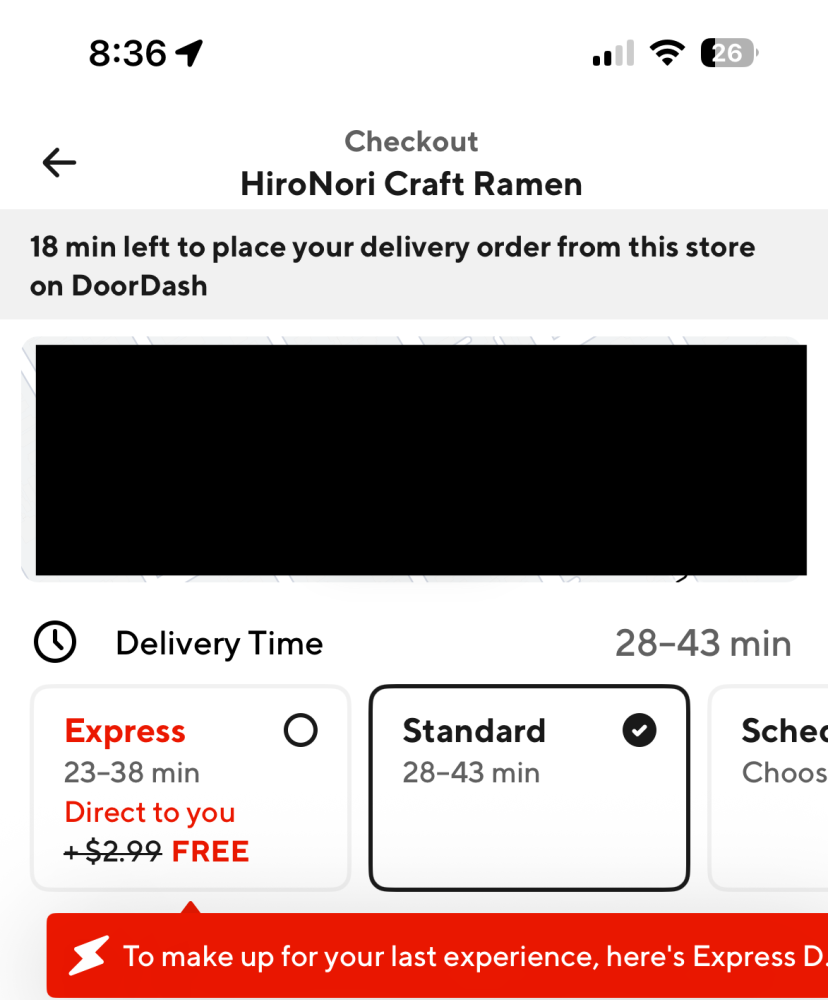
DoorDash just launched an “Express” option for delivery in their app. I love the concept of express delivery, but I have one burning question: How?
Let’s be honest about DoorDash’s delivery promises. The estimated delivery time is already a best-guess estimate that changes dynamically as things go sideways.
Dashers wait for food that’s not ready. Traffic happens. Weather delays everything.
My food is almost never delivered within the originally quoted time window.
So how exactly can they promise an even quicker delivery window?
First, let’s acknowledge their obvious goal: make more money.
And logically, I should pay more for speed, right? But when the baseline service can’t hit its own estimates, charging extra for “faster” delivery raises some interesting questions about what’s actually happening behind the scenes.
The Current DoorDash Fee Structure
Before we dive into Express, let’s look at what we’re already paying:
- Service Fee: Platform operation costs (varies by order size)
- Delivery Fee: Getting your order to you (varies by location/demand)
- Small Order Fee: Making tiny orders worthwhile to fulfill
- Long Distance Fee: Ordering from restaurants further away
- Regulatory Response Fee: When local regulations increase DoorDash’s costs
- Other Mandatory Fees: Government-required charges
That’s a lot of fees as DoorDash’s core monetization strategy.
At some point, you have to wonder if they’ve exhausted the creative naming possibilities for new ways to extract revenue per transaction. Express feels like the next logical step when you’ve run out of operational costs to itemize separately.
Three Theories on How Express Could Work
Theory #1: The Innovation Approach
DoorDash works directly with restaurants to prioritize Express orders.
This requires:
- Restaurant buy-in: Establishments agree to bump Express orders to the front of their kitchen queue
- Value exchange: DoorDash either shares the Express fee with restaurants, provides promotional advertising, or steers non-Express customers away from non-participating restaurants
- Operational changes: Restaurants modify their workflow to accommodate priority orders
The long pole in this tent is getting restaurant agreement. Restaurants would need to see clear value - either financial incentives or competitive pressure - to disrupt their existing operations for DoorDash’s premium service.
What needs to be true: Restaurants must believe the partnership benefits them more than it disrupts their normal operations.
Theory #2: The Enshittification Approach
Express isn’t faster - everything else just got slower. This is the classic “prices go up before a sale so things can be marked down to regular price” strategy.
In this scenario:
- Current delivery times become “Standard” and get deliberately slowed down
- Express delivery is just the old “normal” service with a premium price tag
- Customer perception shifts to view the degraded service as baseline, making Express seem like a genuine upgrade
This approach requires no operational innovation, no restaurant partnerships, and no actual improvement in logistics. It’s pure margin expansion through service tier manipulation.
What needs to be true: Customers don’t notice the baseline service degradation, or they accept it as market conditions.
Theory #3: The Vaporware Approach
It just ain’t real!
Express is marketing with a price tag attached - a premium fee for a promise that can’t be consistently delivered. But here’s where this gets legally interesting: promising faster delivery for additional payment could open DoorDash up to false advertising claims.
What would need to be true to avoid lawsuits:
- Clear disclaimers about delivery time estimates
- Automated refund processes for missed Express windows
- Careful language around “estimated” vs “guaranteed” delivery times
- Data showing Express orders do perform better, even if not consistently
The legal safety net probably lies in the same fine print that protects current delivery estimates: everything is an estimate, subject to conditions beyond their control.
The Customer Reality Check
I haven’t used Express (beyond testing it), and here’s why.
First, the cost. Food delivery fees are already exorbitant. While I’m grateful to have delivery as an option - especially when I’m stuck at home alone with kids and the fridge is empty - I’m already paying a premium for convenience. Adding another fee layer feels like death by a thousand cuts.
Second, the trust issue. Current delivery estimates are consistently wrong. Why would I pay extra for an even more aggressive delivery window from a platform that can’t hit its existing targets?
But here’s the thing: I believe Express will be wildly successful anyway.
Why? Because anyone already using DoorDash has demonstrated they have disposable income for convenience. A couple extra bucks for a “premium” experience? That’s an easy psychological sell, regardless of whether the underlying service actually improves.
The Bigger Picture
Express delivery reveals something fascinating about platform business models in mature markets. When growth slows, platforms have three options:
- Genuine innovation that creates new value
- Service tier manipulation that extracts more value from existing services
- Marketing illusions that charge premium prices for unchanged experiences
The truth about DoorDash Express probably lies somewhere between all three approaches. Some restaurants might genuinely prioritize Express orders. Some baseline service might get quietly degraded. Some customers might pay extra for service that’s indistinguishable from what they used to get for free.
The most successful platform features aren’t always the most technically impressive - they’re the ones that successfully monetize customer psychology.
Express delivery isn’t really about logistics innovation. It’s about willingness to pay for the perception of priority treatment in an already premium service.
And honestly? In a world where my dinner depends on a gig worker navigating traffic to pick up food from a restaurant that may or may not have it ready, paying a few extra dollars to feel like I’m at the front of some imaginary line doesn’t seem that unreasonable.
The question isn’t whether Express delivery works. The question is whether we care, as long as it feels like it might.
What’s your take? Have you tried Express delivery? And more importantly - did it actually feel faster, or just more expensive? Let me know.